Granularity of Regional Homogeneity Changes in MDD (UKBB)

Project Overview
Major depressive disorder (MDD) is a prevalent psychiatric disorder with complex functional brain alterations. Standard brain atlases often dilute subtle disorder-specific effects in functional MRI analyses. This project introduces a data-driven, MDD-specific parcellation framework using Kullback-Leibler (KL) distance optimization to define cortical regions that maximize signal-to-noise for Regional Homogeneity (ReHo) measures in UK Biobank resting-state fMRI.
Original Article:
Exploring the Granularity of Illness-Related Changes in Regional Homogeneity in Major Depressive Disorder using UKBB Data — Pacific Symposium on Biocomputing (PSB) 2025 / World Scientific
DOI: 10.1142/9789819807024_0046
🔑 Key Highlights
- Disorder-specific parcellation: KL distance is used to derive MDD-optimized cortical regions that increase contrast between cases and controls.
- Enhanced RVI (Regional Vulnerability Index): Using MDD-specific regions produces larger effect sizes than standard anatomical atlases (e.g., Desikan).
- Large-scale validation: Dataset includes 2,289 MDD cases and 6,104 healthy controls from UK Biobank.
- Methodological innovation: Combines functional ReHo mapping with KL distance optimization for precise individual-level biomarkers.
- Translational potential: Provides templates for functional biomarker extraction, stratification, and longitudinal monitoring.
🧠 Scientific Background
Functional brain alterations in MDD, particularly measured by ReHo (local BOLD signal synchrony), are heterogeneous and subtle. Standard atlas-based approaches average over large regions, reducing sensitivity. The adaptive KL parcellation framework:
- Preserves illness-relevant signal variation
- Maximizes statistical contrast for individual-level predictions
- Can be generalized to other psychiatric or neurodegenerative disorders
🔬 Methodological Pipeline
Stepwise workflow:
- Preprocessing: Resting-state fMRI from UK Biobank processed (motion correction, normalization, filtering).
- ReHo computation: Local synchrony measured voxel-wise.
- KL parcellation: Derive data-driven cortical regions maximizing illness effect and SNR.
- RVI computation: Regional Vulnerability Index calculated with adaptive parcels vs standard atlases.
- Statistical validation: Large cohort evaluation demonstrates enhanced sensitivity of MDD-specific parcellations.
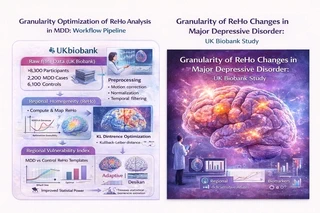
Conceptual workflow from raw fMRI to optimized MDD-specific ReHo biomarkers.
🧬 Multi-Modal & Translational Integration
While primarily focused on functional MRI, this framework can be extended to genetics, transcriptomics, and multi-omics data:
- Integrate RNA-seq or GWAS data with ReHo-derived regions
- Link functional vulnerability to molecular signatures
- Enable mechanistic insights for precision psychiatry
- Supports cross-disorder comparisons for schizophrenia, bipolar disorder, etc.
This multi-modal perspective enhances collaboration opportunities in computational psychiatry, functional genomics, and translational neuroscience.
🧠 Impact & Applications
- Enables individualized ReHo biomarker extraction
- Increases statistical power for translational studies
- Provides template for adaptive parcellation in future studies
- Facilitates clinical deployment for monitoring treatment response
👥 Authorship & Credits
This project is based on the PSB 2025 / World Scientific publication:
- Yewen Huang, PhD – Conceptualization, algorithm design
- Syed Ibrar Hussain, PhD – Computational modeling, statistical analysis
- Paul M. Thompson, PhD – Neuroimaging genetics expertise
- Peter Kochunov, PhD – Translational psychiatry & imaging
- Additional Co-authors: Demetrio Labate, Robert Azencott, Bhim Adhikari
📄 Publication Reference
DOI: 10.1142/9789819807024_0046
🤝 Collaboration & Future Directions
- Extend adaptive parcellation framework to multi-omics datasets (e.g., transcriptomics, proteomics)
- Comparative atlas studies in schizophrenia, bipolar disorder, or anxiety
- Individual-level RVI biomarkers for clinical research
- Opportunities for collaborations in computational psychiatry, precision imaging, and multi-modal biomarker discovery
